If you want a workout that trains your body, sharpens your focus, and gives you real skills, this is it.
Jiu jitsu is one of the rare workouts where you can feel progress in more than one place at once: your lungs, your muscles, and your mindset. In Orange, MA, that matters because most adults are juggling work, family, and stress, and time is tight. When you show up for training, you want your hour to count.
We also like that this isn’t just “get sweaty and go home.” You’re learning a skill, solving problems in real time, and building confidence the honest way, through reps and small wins. Research backs up what we see on the mats: adults report improved confidence (87.6 percent), reduced anxiety (87.5 percent), improved mood (96.9 percent), and a strong sense of community (100 percent) through Brazilian Jiu-Jitsu training.
If you’ve been searching adult jiu jitsu Orange MA because you want a program that’s practical, challenging, and surprisingly fun once you settle in, we built our classes to fit real lives here in Franklin County.
What makes jiu jitsu the “ultimate” mind-body workout
A lot of fitness programs separate “cardio days” from “strength days” and leave “mental health” as something you handle later. Jiu jitsu blends all three, and it does it in a way that stays interesting. Every round is different because every partner is different, and that variety is a big reason adults stick with it.
Physically, you’re pushing and pulling, stabilizing, bridging, rotating, and moving your body through angles you don’t hit on a treadmill. Mentally, you’re forced to stay present. If your mind wanders, you feel it immediately, and then you learn to bring your attention back. That loop, over and over, becomes a kind of training for daily life.
And yes, it’s a serious workout. Depending on intensity and experience, many people burn roughly 300 to 800 calories per session. But the bigger story is how your conditioning improves without the mental drag of repetitive cardio.
Fitness benefits you can actually feel week to week
We keep training structured so you build capacity safely, especially if your current routine is mostly sitting, commuting, and trying to squeeze in movement when you can. With consistent attendance, most adults notice improvements in a few key areas:
• Cardiovascular endurance that shows up in everyday tasks, like stairs, yard work, and carrying groceries
• Muscular strength and endurance from constant full-body tension and controlled movement
• Mobility and flexibility that develop naturally as you learn positions and escapes
• Balance and coordination because you’re always managing weight shifts and base
• Better recovery habits because training tends to make sleep, hydration, and nutrition matter in a practical way
This is a big reason jiu jitsu Massachusetts programs have grown so much in adult enrollment. It’s not just exercise, it’s a system you can keep improving for years.
The mental side: stress relief, focus, and confidence that transfers
One of the most underrated benefits of jiu jitsu is how it changes your relationship with stress. During sparring, your body gets the signal that something is “hard,” but you learn to breathe, think, and act anyway. That’s stress inoculation, and it carries over.
Studies report that 87.5 percent of adult practitioners notice reduced anxiety, and 96.9 percent report improved mood. We see a simple pattern: you come in tense, you train with intention, you leave lighter. Not because life got easier in an hour, but because your nervous system got practice settling down while your body worked.
Why jiu jitsu builds confidence without hype
Confidence is tricky. You can’t talk your way into it for long. You build it by doing difficult things with good coaching and steady repetition. In training, you learn what you can handle, and you also learn what you can learn. That second part matters.
When adults report improved confidence at rates around 87.6 percent, it tracks with what we teach: you don’t need to be “tough,” you need to be consistent. When you start solving problems on the mat, you start trusting your ability to solve problems off the mat too.
Technique over strength: why this works for beginners and older adults
A common concern we hear is, “Am I too out of shape?” or “Am I too old to start?” The honest answer is that jiu jitsu is one of the more adaptable martial arts for adults because technique creates leverage. You can scale intensity, choose training partners thoughtfully, and focus on positional learning before you worry about speed.
We run beginner-friendly classes with clear structure: warm-ups that prepare your joints and breathing, drilling that builds pattern recognition, and controlled sparring that keeps learning the priority. If you’re brand new, you’ll spend plenty of time learning how to move safely: how to fall, how to frame, how to protect your neck and shoulders, and how to tap early.
What “low impact” really means in training
Grappling is physical, but it doesn’t have to be reckless. “Low impact” doesn’t mean “easy.” It means we can reduce unnecessary collisions and keep training focused on control. The mat gives you a safer surface, and the culture of tapping and resetting makes it possible to train hard without taking the kind of hits that add up over time.
That’s also why many first responders and service professionals gravitate toward this kind of training. Injury reduction and better body control are practical outcomes, and research in tactical populations even points to meaningful reductions in injury rates with the right training approach.
Why adult classes feel different than you might expect
Adult jiu jitsu Orange MA classes tend to attract people who want a productive hour, not a loud scene. Most adults want training that’s welcoming, structured, and efficient. We respect that.
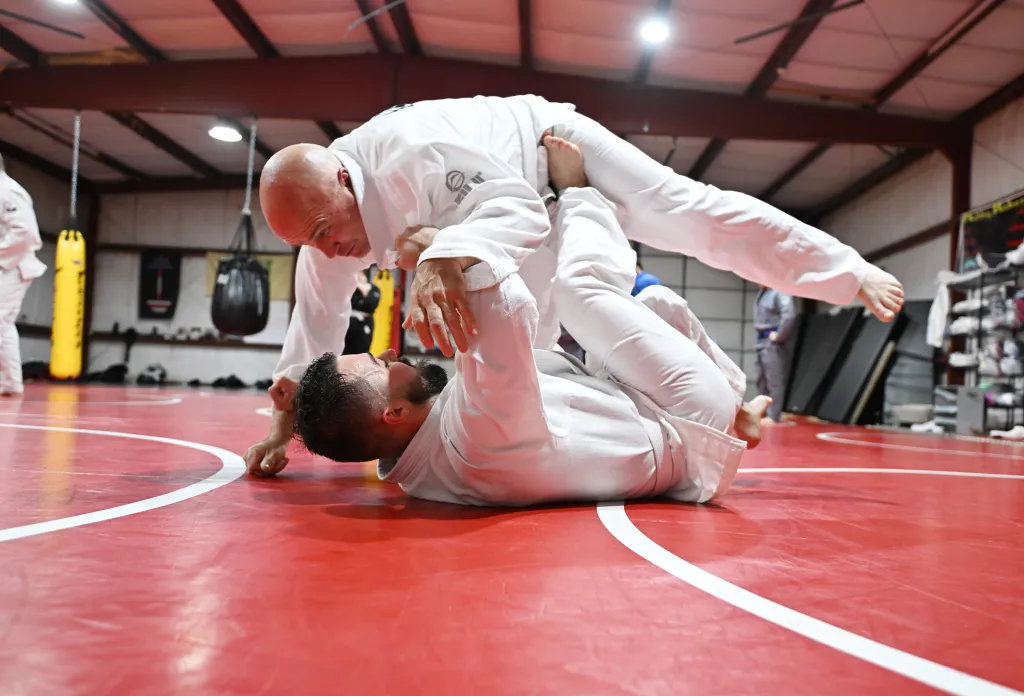
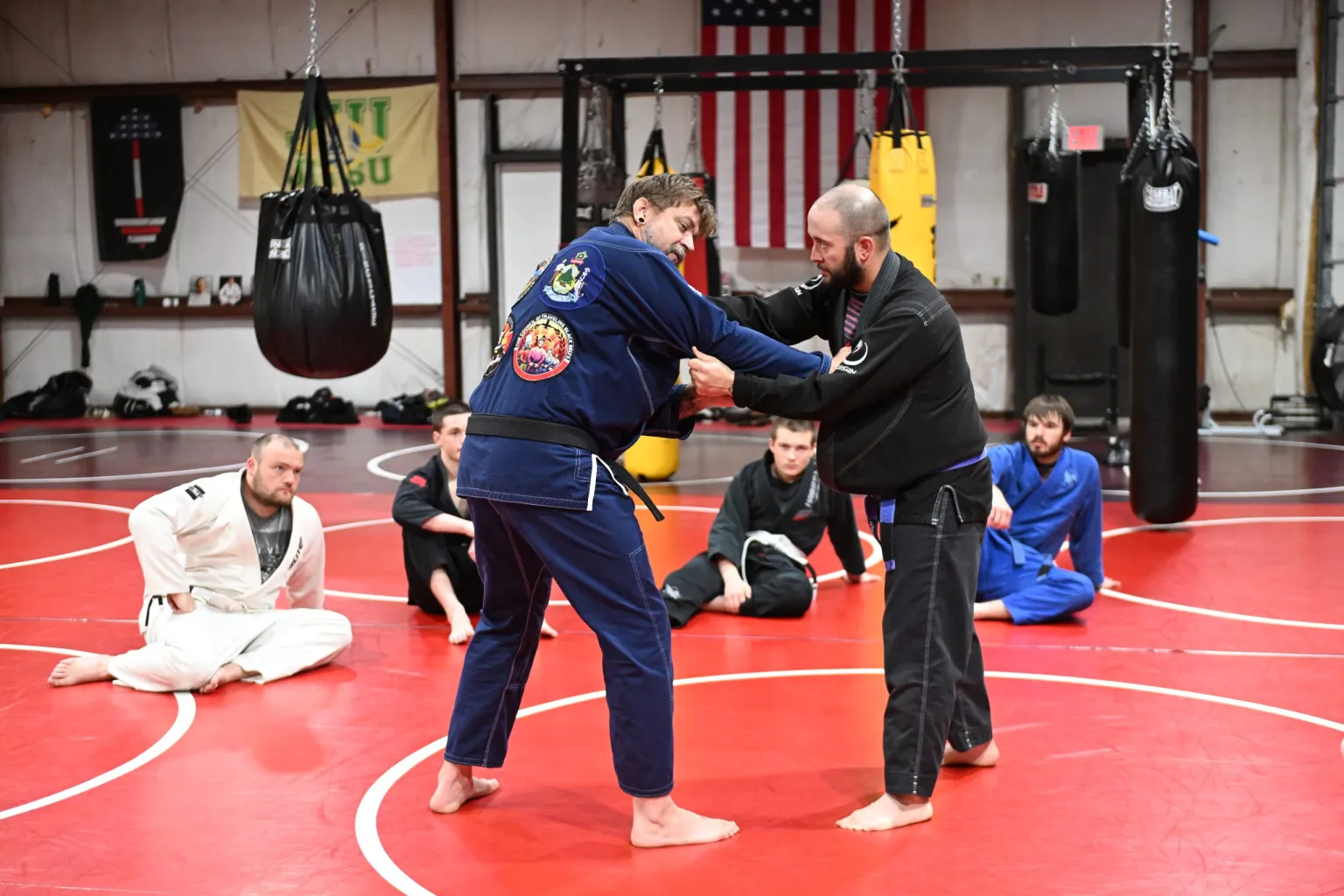
A typical class includes technique instruction, partner drilling, and optional sparring with guidance. You’ll rotate partners when it makes sense, but you’re never thrown into the deep end without context. We coach you to learn the “why” behind a movement, not just copy shapes.
What you’ll learn first (and why it matters)
We teach fundamentals in a way that makes your early months smoother. Instead of chasing random moves, we focus on positions that show up constantly:
• Escaping bad positions so you can breathe and reset
• Guard fundamentals for control, distance management, and off-balancing
• Top pressure basics that rely on alignment rather than brute force
• Simple submissions taught with safety and mechanics first
• Positional sparring that lets you repeat the same scenario until it clicks
This is where the mind-body part really shows up. You’re training awareness, timing, and calm decision-making while your heart rate climbs.
The “flow state” effect: why an hour on the mat can feel like a reset button
There’s a specific feeling many students describe after class: grounded, alert, and quietly tired in a good way. That’s not an accident. Jiu jitsu demands enough attention that your brain doesn’t have room to spiral through emails, bills, and what-ifs.
Call it mindfulness, call it flow, call it just being present. Either way, your breathing improves, your focus narrows to the task, and you get a break from mental noise. Then your body gets endorphins, your muscles get worked, and you sleep better. For a lot of adults, that combination is exactly what they’ve been missing.
Community in a small town: why connection keeps you consistent
Orange is the kind of place where community matters, even if people don’t always say it out loud. One reason Brazilian Jiu-Jitsu keeps growing is that it creates a built-in training circle. Research even shows 100 percent of surveyed practitioners reporting a strong sense of community.
In class, you’ll learn names, you’ll get help, and you’ll help someone else a few weeks later. That’s how it goes. The mat has a way of flattening social barriers because everyone taps, everyone struggles, and everyone improves. Consistency gets easier when you know people expect to see you and you actually want to show up.
How we structure progress: belts, goals, and real-world fitness
Adults do best with clear benchmarks. Belts are one part of that, but we also emphasize practical milestones: smoother movement, better breathing, smarter decisions, and the ability to stay calm under pressure. Those are measurable, even if they aren’t always flashy.
We encourage you to set a simple training rhythm first. Two days a week is enough to build momentum. Three days a week is where many adults start to feel major changes in conditioning and confidence. And if you can only make one day some weeks, we’d rather have you train once than disappear for a month.
A simple way to get started without overthinking it
If you’re new, here’s a straightforward approach we recommend:
1. Pick two class times from the class schedule that you can realistically keep for eight weeks
2. Show up early enough to settle in, stretch, and ask a quick question if you have one
3. Focus on one theme per week, like escapes, guard retention, or posture
4. Keep sparring controlled, and treat tapping as part of learning, not “losing”
5. Track small wins, like lasting longer in bad positions or remembering a sequence under pressure
That process is where the mental toughness develops. You’re practicing patience, humility, and problem-solving, which is why 96.9 percent of adults report that life skills from BJJ transfer into daily life.
Self-defense value without fear-based training
Jiu jitsu is effective for self-defense because it teaches you how to manage distance, control a resisting person, and escape bad scenarios using leverage. We keep training realistic but responsible. You’ll learn how to protect yourself, and you’ll also learn when to disengage and create space.
For many Massachusetts adults, self-defense is less about “winning a fight” and more about feeling capable. When you understand grips, balance, posture, and how to stand up safely, your confidence changes in everyday situations. You’re not looking for trouble. You’re just not helpless.
Recovery and longevity: how to keep training for years
The goal isn’t to train hard for three months and burn out. The goal is to build a practice you can maintain. That’s why we talk about recovery as part of the program, not an afterthought.
A few habits make a big difference: sleep, hydration, light mobility work, and learning when to go lighter. We also coach you to communicate with training partners. If your neck is tight or your knee is cranky, say so. Smart training is long-term training.
Take the Next Step
Building a stronger body and a steadier mind doesn’t require a complicated routine, but it does require a practice you’ll actually stick with. That’s what we aim to provide every time you step on the mat: structured coaching, challenging rounds, and a supportive environment where progress feels real.
If you’re ready for adult jiu jitsu Orange MA training that delivers fitness, focus, and community in one place, we’d love to help you start. At Roberts Family Mixed Martial Arts, we keep the path clear for beginners while still giving experienced students plenty to sharpen, so you can grow at your own pace.
Strengthen both your body and mindset through martial arts training at Roberts Family Mixed Martial Arts.
ACCESS OUR SCHEDULE
& EXCLUSIVE WEB SPECIAL
Secure your spot and get started today with our EXCLUSIVE offer!