
Jiu jitsu turns “stiff and achy” into “loose and capable” by teaching your body to move the way joints were built to move.
If you live or work around Orange, MA, you already know how easy it is to get tight: long drives, desk hours, repetitive lifting, and the kind of New England cold that makes hips and backs feel a little creaky. The good news is that jiu jitsu can be a practical, low-impact way to restore mobility and support joint health without needing to be a “gym person.”
In our adult program, we see a common pattern: you might show up thinking you need tougher workouts, when what you really need is better movement. Jiu jitsu helps you build that through controlled, natural ranges of motion like hip shifts, smooth rolling, and shoulder positioning, all practiced in a structured way that respects your current limitations.
This article breaks down exactly how jiu jitsu supports mobility and joint health, what training looks like for beginners (including adults over 40), and how consistent practice can make everyday life in Orange feel easier on your body.
Why mobility and joint health matter more than “fitness” as you get older
Mobility is the ability to move freely with control, and joint health is the long-term comfort and function of the joints you rely on every day. When either one slips, you feel it everywhere: getting out of the car, climbing stairs, carrying groceries, even sleeping comfortably. Many adults in our area are active in spurts but still spend a lot of time sitting, which is a perfect recipe for tight hips, stiff spines, and cranky knees.
Jiu jitsu is different from many workouts because it trains movement in multiple directions, at multiple speeds, and with real feedback from another person. That matters because joints do not just need stretching, they need strength and control at the edges of your range of motion. Over time, that combination can reduce the sense of “stuckness” that builds up from routine posture and repetitive tasks.
In other words, jiu jitsu is not only exercise. It is movement education with a purpose, and your joints tend to appreciate that.
How jiu jitsu builds mobility without beating up your body
A common worry we hear is whether grappling will hurt your joints. It is a fair question. The reality is that when training is coached well and paced correctly, jiu jitsu tends to improve joint motion through controlled positions and transitions instead of high-impact pounding.
The secret is in the ground movement
In daily life, most of us move in straight lines: walk forward, sit down, stand up. Jiu jitsu adds patterns you rarely practice otherwise, such as:
• Hip escapes and hip shifts that teach the pelvis to move independently from the ribs
• Spinal rolls that gently train flexion, extension, and rotation with control
• Shoulder framing and posture drills that wake up the small stabilizers around the shoulder blade
• Guard movement that asks your hips, hamstrings, and ankles to cooperate instead of fighting each other
Because these motions are repeated frequently, your nervous system starts to “allow” range of motion again. That is one reason many adults report less morning back tightness and easier bending within a few weeks of consistent training.
Mobility plus stability equals safer joints
Flexibility alone is not enough. If a joint is flexible but unstable, it can feel worse, not better. Jiu jitsu builds stability because you are constantly learning to keep alignment under mild pressure. You learn where your knees track, how your hips stack, and how to keep your shoulders safe while you move.
That stability is one of the most underrated parts of joint health. It is also a big reason jiu jitsu can be a longevity-focused practice when you train intelligently.
What we do in class to support your joints, especially as a beginner
We teach adults with a wide range of starting points, including people who have not trained in years. Our priority is to help you learn movement mechanics first, then add intensity later. You do not need to be flexible to begin. You build flexibility by training.
Here are a few joint-friendly habits we emphasize from day one:
• Controlled pace over “winning” rounds, especially early on
• Tapping early and often so your joints stay safe while you learn
• Clean technique that reduces strain, like using hip angle instead of cranking with arms
• Partner awareness so you and your training partner can improve together
• Progressive drilling that lets your body adapt over time
This approach is especially relevant for adult jiu jitsu Orange MA students who want results without feeling like the class is a toughness contest.
The mobility payoff: hips, spine, shoulders, and knees
Mobility is not one thing. Most adults feel limitations in predictable places, and jiu jitsu happens to target them naturally.
Hip mobility: the “hidden” driver of comfort
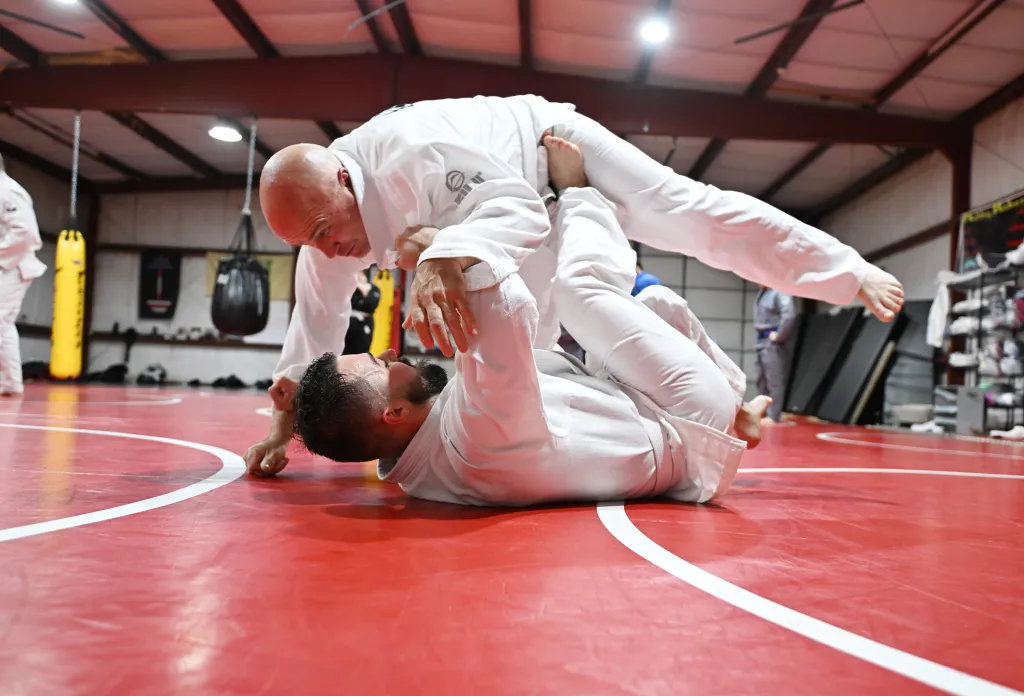
Tight hips can show up as low back tension, knee discomfort, or a stiff stride. Jiu jitsu addresses hip mobility through constant transitions on the ground. Hip escapes alone can help you learn to rotate and extend the hip in a controlled way, while guard movement encourages smooth opening and closing of the hips.
When hips move better, daily life tends to feel better. Walking, stairs, and getting up from the floor all get less dramatic.
Spinal flexibility: moving like a spine again
A spine is meant to flex and rotate, but sitting patterns often lock it into one position. Jiu jitsu introduces safe spinal curves through rolling, shrimping, and technical stand-ups. Because you are practicing these motions repeatedly, you build confidence in movement again, not just range.
We also pay attention to posture and bracing, so you get the benefit without turning your lower back into the “hero” that does all the work.
Shoulder health: stability in messy positions
Shoulders get cranky when the joint is asked to do too much without support from the shoulder blade and upper back. Jiu jitsu trains you to frame, post, and connect your arms to your torso so the shoulder is not floating on its own.
Over time, many students notice everyday improvements: reaching overhead feels smoother, carrying bags is easier, and the neck and upper traps relax because the shoulder girdle is doing its job.
Knees and ankles: stronger alignment, better control
Knees usually feel better when hips and ankles move better and when your knee tracks correctly. Jiu jitsu teaches you to rotate, pivot, and base with awareness. We coach alignment constantly because it matters for longevity.
If you have a history of knee issues, we modify positions and help you choose ranges that build strength and control without forcing discomfort.
Why jiu jitsu works well for adults over 40 and desk workers
Recent trends in jiu jitsu Massachusetts communities have leaned hard into adult wellness, and it makes sense. Adults over 40 are not looking for punishment. You want something that improves how you feel, how you move, and how long you can stay active.
Jiu jitsu tends to fit that goal because it is scalable. You can train with plenty of technique and moderate intensity and still make meaningful progress. You are also not stuck doing the same repetitive machine pattern. You are solving movement problems, which keeps training mentally engaging too.
We also notice a psychological side effect that is easy to overlook: consistent practice often improves mood and resilience. You get a focused hour where you are not scrolling, not stuck in your own head, and not dealing with work stress. You are present, moving, learning.
A simple timeline: what to expect in 4 to 6 weeks
Joint health improvements are not magic, but they are real when you train consistently. If you come in 2 to 3 times per week, many beginners notice changes within the first month or so.
Here is a realistic progression we often see:
1. Week 1 to 2: You learn basic positions and start moving more, but you might feel “new muscles” waking up.
2. Week 2 to 3: Movements like hip escapes and stand-ups feel less awkward, and stiffness starts to ease.
3. Week 3 to 4: You notice better control in transitions and less tension in common tight spots like hips and upper back.
4. Week 4 to 6: Range of motion improves more noticeably, and daily tasks feel smoother and more stable.
This is one reason we encourage consistency over intensity. A steady pace is what your joints respond to best.
How jiu jitsu translates to daily life in Orange, MA
Mobility is only valuable if it shows up outside the gym. For many adults here, “real life” includes long workdays, lifting and carrying, yardwork, and weekend activities that are fun until your back argues with you the next morning.
Jiu jitsu helps because it builds functional strength in the exact places that protect joints: hips, glutes, core, and upper back. It also builds coordination between those areas. Instead of isolating muscles, you learn to connect your body as one unit, which is how you move in the real world.
Better circulation is another underrated benefit. Grappling is full-body work, so you often leave class feeling warm, loose, and more energized, not wrecked. That circulation supports recovery, and recovery is a big part of joint health.
Common questions we hear about joints and training
Does jiu jitsu hurt joints or improve them?
When training is coached and controlled, jiu jitsu typically improves joint mobility and reduces stiffness. The key is learning proper mechanics, tapping early, and building up gradually.
Is it suitable for total beginners?
Yes. We start with foundational movements and positional skills. You do not need prior experience, and you do not need to be “in shape” before you begin.
What about injury risk?
Any physical activity has risk, but we manage risk through coaching, partner selection, structured drilling, and a culture that values safe progress. Improved stability and body awareness can also reduce day-to-day injury risk outside class.
How often should you train for mobility gains?
Most adults do well with 2 to 3 sessions per week. Consistency matters more than going hard once in a while.
Ready to feel better in your body?
If your hips feel tight, your back feels stiff, or your joints just feel older than you want them to, our adult classes are designed to help you move naturally again. The goal is not to “win” training, it is to build the kind of mobility and control that supports you for the long haul, whether you are brand new or returning after time away.
We built our adult jiu jitsu Orange MA program to be approachable, structured, and realistic for busy adults, and we coach you toward joint-friendly technique that holds up over time. When you are ready to train in a way that improves how you feel in everyday life, we would love to help you get started at Roberts Family Mixed Martial Arts.
Ready for next steps? Use the website to check the program details, the class schedule, and the easiest way to reach us.
Build stronger fundamentals and sharpen your technique by joining a martial arts class at Roberts Family Mixed Martial Arts.
ACCESS OUR SCHEDULE
& EXCLUSIVE WEB SPECIAL
Secure your spot and get started today with our EXCLUSIVE offer!